Radiology + cardiology
A consistent path from eligible imaging to review, outreach, and established preventive services.
Requires prospective workflow and outcome validation
For health systems
Give radiology and cardiology teams a new way to notice an aging signal in CT studies already moving through care, then connect the right patient to an appropriate clinical conversation.
CardioSight is investigational and not FDA-cleared. The interface shown here is a workflow prototype, not a currently deployed PACS integration.
The value to the care team
Confidence that a patient who looks low-risk on paper is not quietly being missed.
More signal
Use information already present in imaging.
Less friction
Return context where clinicians already work.
Clearer routing
Move from signal to an accountable review queue.
PACS-side workflow concept
A future DICOMweb and SMART on FHIR integration could return Heart Age, localization, and review status inside the imaging workflow. Early pilots begin with secure study transfer before this level of automation.
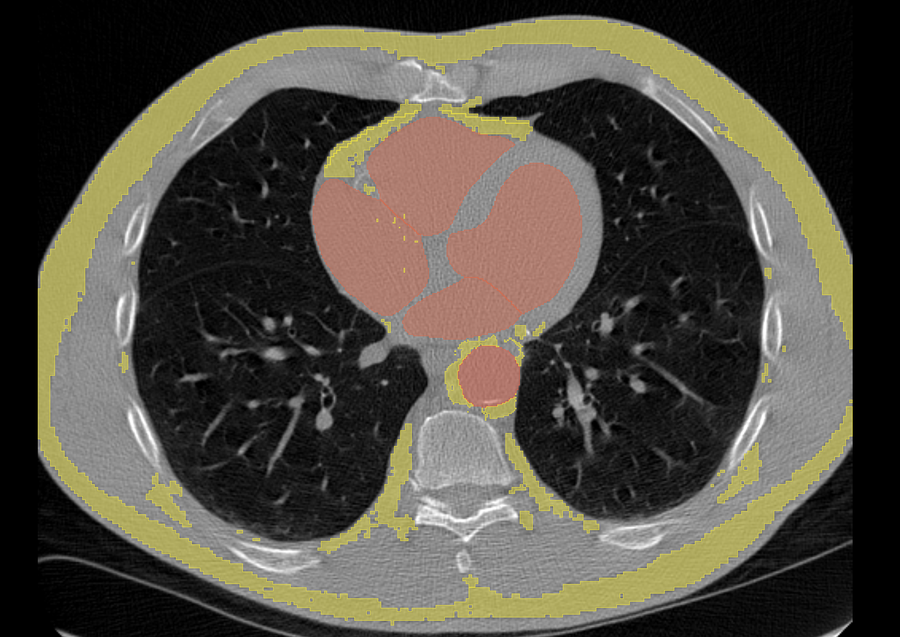 peri-aortic ROI
01
Study arrives
Eligible CAC or chest CT enters the defined workflow.
02
Signal is localized
The model maps anatomy and the peri-aortic imaging phenotype.
03
Heart Age returns
The result includes reference placement and model context.
04
Team owns the next step
A clinician reviews, dismisses, or routes the study for follow-up.
Pilot before platform
The first question is not whether we can connect every system. It is whether the signal helps a real clinical team identify an appropriate follow-up opportunity and fit it into a responsible workflow.
01
Define the cohort
Choose eligible CAC or chest CT studies and the clinical review pathway.
02
Transfer studies
Early pilots use a secure, controlled study-transfer workflow.
03
Return Heart Age
CardioSight returns a localized signal, population context, and review status.
04
Route follow-up
Your clinical team decides which patients warrant outreach or established prevention pathways.
Radiology + cardiology
A consistent path from eligible imaging to review, outreach, and established preventive services.
Requires prospective workflow and outcome validation
Life sciences research
Explore whether a therapy changes an imaging-derived cardiovascular phenotype, not only a conventional biomarker.
Requires prospective workflow and outcome validation
Population health
Study where imaging-derived aging may add context to existing risk stratification and care-management programs.
Requires prospective workflow and outcome validation
We are speaking with a small number of radiology, cardiology, and research teams. Tell us about your study volume, current follow-up pathway, and the question you need the signal to answer.